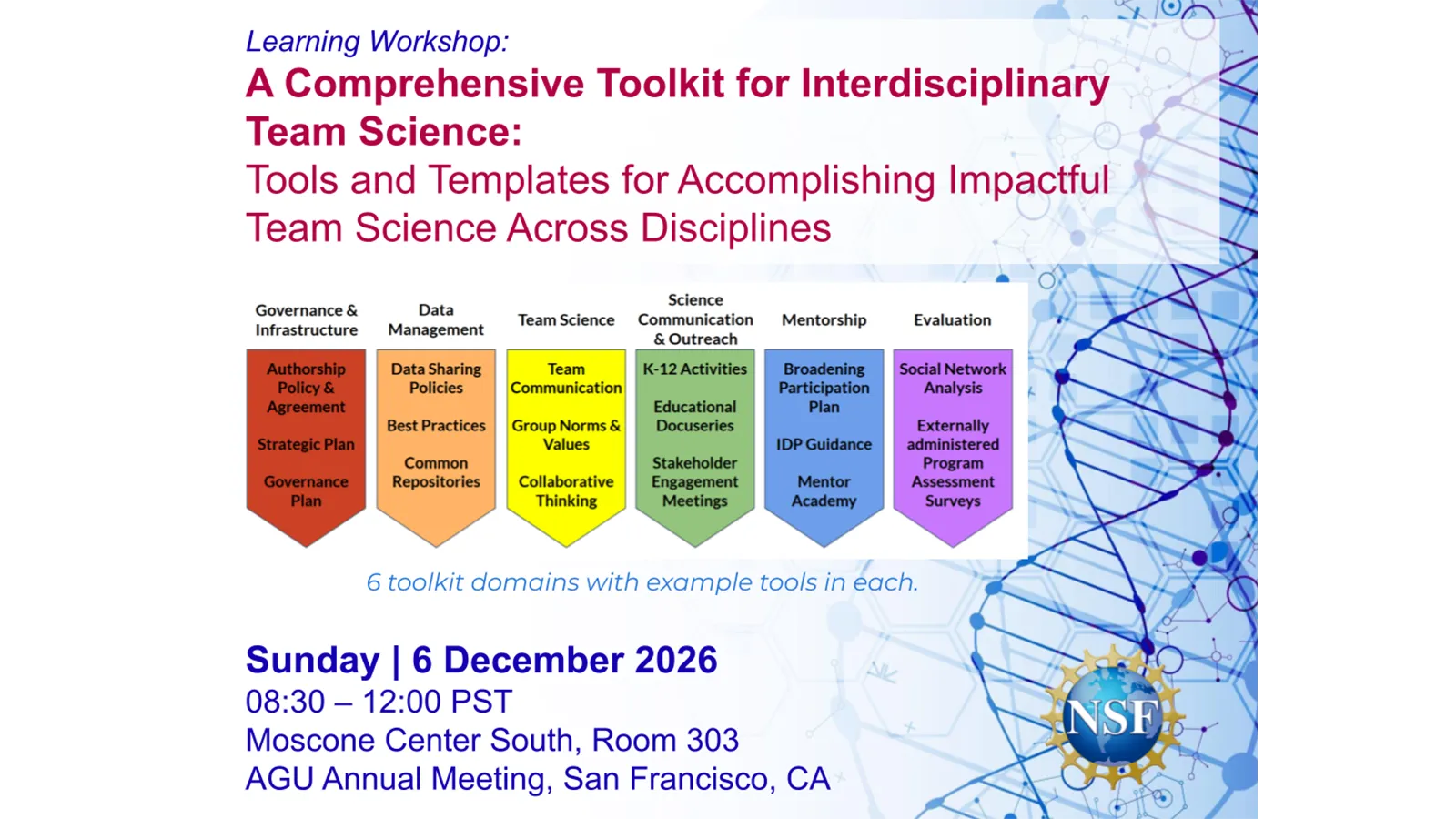
Note, AGU Learning Workshops precede the general meeting, occurring during the day Sunday, so travel must be booked to arrive earlier than for the meeting itself.
This workshop will occur Sunday Dec 6th 8:30am - 12pm Pacific, and is Session # SCIWS01, workshop ID 282980. Registration for the workshop opens late-September through the AGU registration portal. AGU26 scientific workshops are ticketed events and attendees must pay a separate fee to attend (typically $95, or $45 for students), in addition to overall meeting registration.
Thanks so much for considering if this workshop would be of value to you!
The Cross-BII Research Coordination Network
Learning Workshop Description:
This workshop will benefit early-, mid-, and late- career scientists interested in participating in, launching, or leading multidisciplinary scientific teams. Workshop participants will receive and learn to apply a toolkit of resources for accomplishing interdisciplinary team science. The toolkit spans 6 domains: Governance & Infrastructure, Data Management, Team Science, Science Communication & Outreach, Mentorship, and Evaluation. In small-group activities (organized by experience level and interest), participants will work through a selection of key tools and challenges, including reconciling disciplines' different authorship norms, and building effective team communication. Using real-life example guides and templates developed and used by interdisciplinary teams, participants will discuss strategies for applying relevant tools to their own projects, and depart ready to do so. Unlike tools imported into scientific settings from the business community, where differing culture and terminology can create a mismatch with users, this toolkit is built by scientists for scientists. These templates have been tested and refined with teams in a variety of cross-disciplinary contexts, from small teams within a single university to large institutes that cross scientific organization types and countries. The tools from the 6 domains can be applied either as interconnected elements, or used independently:
- Governance & Infrastructure tools include Governance Plans, Strategic Plans, and Broadening Participation Plans (these three required by NSF of all BIIs), as well as codes of conduct, authorship policies and agreements, and workshop planning guides, and have an overarching emphasis on building resilient structures.
- Data Management tools help researchers with organizing and sharing data according to FAIR principles, and include Data Management Plans, Data Sharing Policies, open-source data management software & other technical systems, and guidance on data management best practices.
- Team Science tools provide ongoing clear structures and communication tools to ensure smooth and harmonious team interactions that are essential for team success, and include group norms and values, guidance on team communication and conflict resolution, approaches for building collaborative thinking, and frameworks for defining roles and responsibilities.
- Science Communication & Outreach tools include a variety of science communication and outreach methods (such as stakeholder engagement meetings, activities for K-12 students, and traveling outreach pods) suitable for interdisciplinary cross-institutional projects, as well as implementation guides.
- Mentorship tools include variants for both one-on-one and team mentoring systems, including mentoring charters and agreements, individual development plan (IDP) guides, broadening participation plans, a mentorship academy, a mentoring self-evaluation, and a field safety manual that explains a range of physical and psychological safety considerations and strategies.
- Evaluation tools use a variety of qualitative and quantitative methods to assess outcomes such as researcher capacity development, interdisciplinary collaboration success, and career success pathways; and include participant entry and exit surveys, social network analysis, and measures of research integration.
This toolkit has been developed in a National Science Foundation (NSF)-funded Research Coordination Network (RCN) that works to assemble tools across the NSF Biology Integration Institutes (BIIs). Tool creators include scientists and science-of-team-science sociologists, and many tools incorporate experience- and evidence-based improvements.