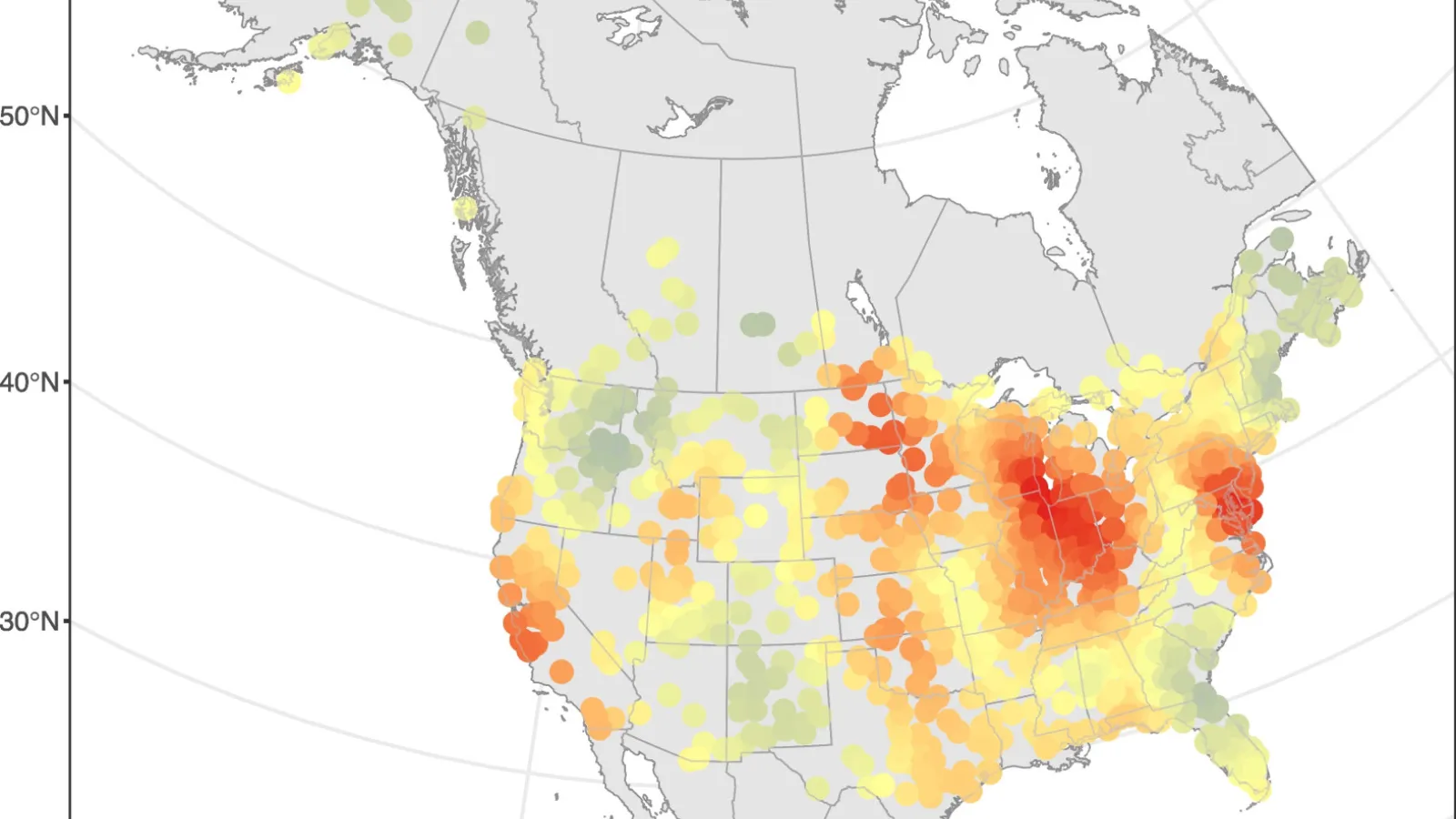
Acceleration hotspots of North American birds’ decline are associated with agriculture
Marta Jarzyna, associate professor of Evolution, Ecology, and Organismal Biology and principal investigator at the Byrd Polar and Climate Research Center, and her colleagues have published new research in Science examining patterns of bird population decline across North America. The study, titled “Acceleration hotspots of North American birds’ decline are associated with agriculture,” identifies regions where bird populations are shrinking and where those declines are increasing in speed.
The researchers analyzed data from the North American Breeding Bird Survey, one of the continent’s longest-running wildlife monitoring programs. Their dataset included observations from 1,033 survey routes, covering 261 bird species, 54 avian families, and 10 habitat types collected between 1987 and 2021.
Human-driven environmental changes, including land use shifts, agricultural intensification, overexploitation of resources, and pollution, have long been known to affect wildlife populations. The researchers suggest that as these pressures have intensified over the past century, declines in bird populations may also be accelerating.
Their analysis found an overall continent-wide decline in bird abundance across local survey routes. The most severe declines were concentrated in southern and warmer regions of North America, while accelerated declines were most prominent in the Mid-Atlantic, Midwest, and California. These areas correspond closely with regions of intensive agricultural activity.
Of the 261 species examined, 122 species (47%) showed significant population declines, and 63 of those species displayed an accelerating rate of decline. These findings suggest that a substantial portion of North American bird species may be experiencing worsening population losses.
The study’s results indicate that bird population declines are not simply ongoing. In many regions they are increasing in speed. According to the researchers, incorporating measures of acceleration into conservation assessments could help scientists detect emerging threats earlier than traditional approaches that focus only on long-term population trends.
The authors also note that this analytical approach could be applied beyond birds. Similar methods could be used to examine other biodiversity indicators, such as species occupancy, richness, or turnover, to determine whether comparable acceleration patterns exist across different groups of organisms.
Hotspots of accelerated bird decline linked to agricultural activity by Emily Caldwell