Beyond the Last Interglacial: 4.5 Million Years of Global Sea Level
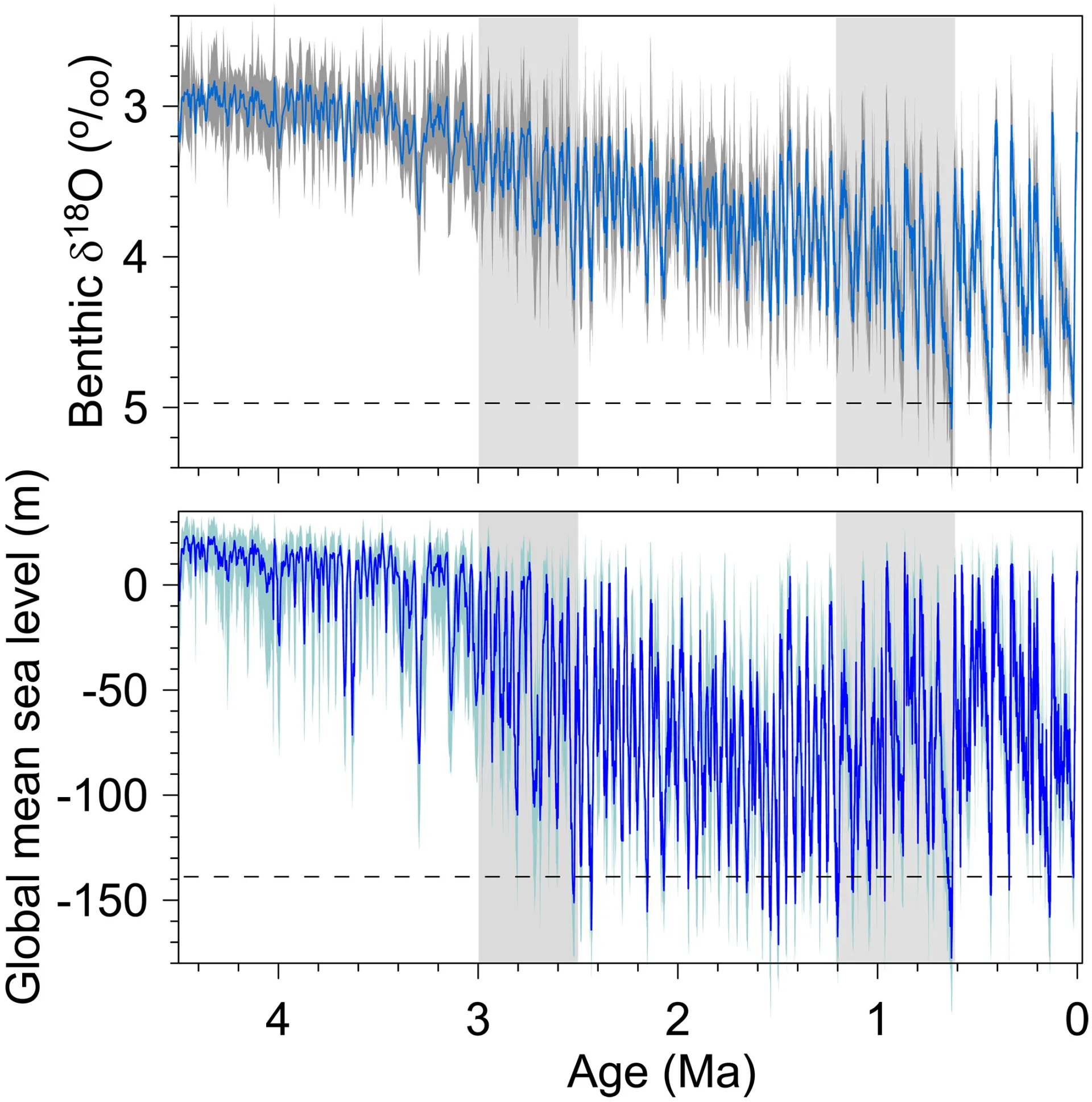
A new study led by Oregon State University paleoclimatologist Peter U. Clark reports that global sea level fluctuated far more dramatically—and more frequently—throughout the last ice age than previously thought, reshaping how scientists view the Mid-Pleistocene Transition and ice-age dynamics. By reconstructing global mean sea level over the past 4.5 million years, the team shows that many early Pleistocene 41-kyr glacial cycles produced sea-level changes comparable to those of the larger, later 100-kyr cycles, implying strong internal climate feedbacks that governed ice-sheet growth and decay. The paper appears in Science.
Co-authors of the study are Steven W. Hostetler and Nicklas G. Pisias of Oregon State University; Jeremy D. Shakun of Boston College; Yair Rosenthal of Rutgers University; David Pollard of Pennsylvania State University; Peter Kohler of the Alfred-Wegener Institute of Germany; Patrick J. Bartlein of University of Oregon; Jonathan M. Gregory of University of Reading of the United Kingdom; Chenyu Zhu of the Chinese Academy of Sciences; Daniel P. Schrag of Harvard University; Max Thomas Professor of Climate Dynamics, Zhengyu Liu, a principal investigator at the Byrd Polar and Climate Research Center, The Ohio State University.
Related Research Article:
New study finds large fluctuations in sea level occurred throughout the last ice age, a significant shift in understanding of past climate, Oct. 16, 2025, Oregon State University, Newsroom.
