High temperatures over northeastern India linked to extreme glacier mass loss on the south-central Tibetan Plateau
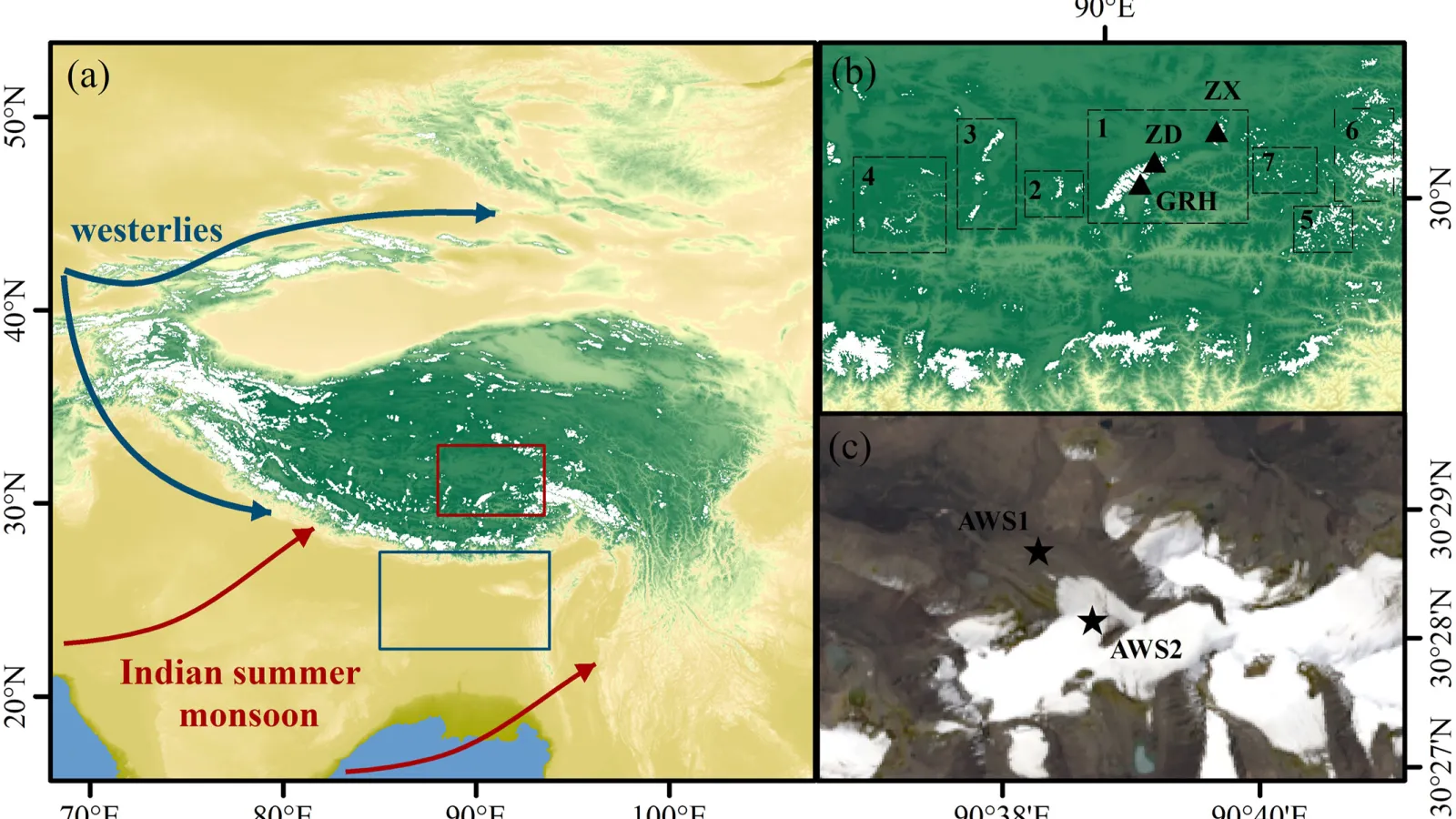
Meilin Zhu of the Center for the Pan-Third Pole Environment at Lanzhou University, together with Lonnie Thompson, Distinguished University Professor in the School of Earth Sciences and Senior Research Scientist at the Byrd Polar and Climate Research Center, and their colleagues have published new research in Journal of Geophysical Research: Atmospheres examining the drivers of extreme glacier mass loss on the south-central Tibetan Plateau.
The study found that extreme glacier mass loss in the region has become more frequent, more intense, and more variable since the 1960s. The researchers linked these events to high air temperatures, which increase radiative and turbulent heat while also reducing snowfall.
Their results also show that extremely high temperatures over the northeastern Indian subcontinent are connected to extreme glacier mass loss on the south-central Tibetan Plateau through warm advection. The findings improve understanding of the atmospheric processes influencing glacier change in the Third Pole region, where glacier loss has important implications for water resources and related hazards.
The paper, "Linking Northeastern Indian Subcontinental High Temperature to Extreme Glacier Mass Loss on the South-Central Tibetan Plateau", was published in Journal of Geophysical Research: Atmospheres.