January 17, 2026
New Ice-Core Method uses Refractory Residual to Trace Arctic Dust
The Ohio State University, School of Earth Sciences (SES), Assistant Professor Emilie Beaudon, co-authored a study proposing a new dust proxy in an Arctic ice core. A principal investigator at the Byrd Polar and Climate Research Center.
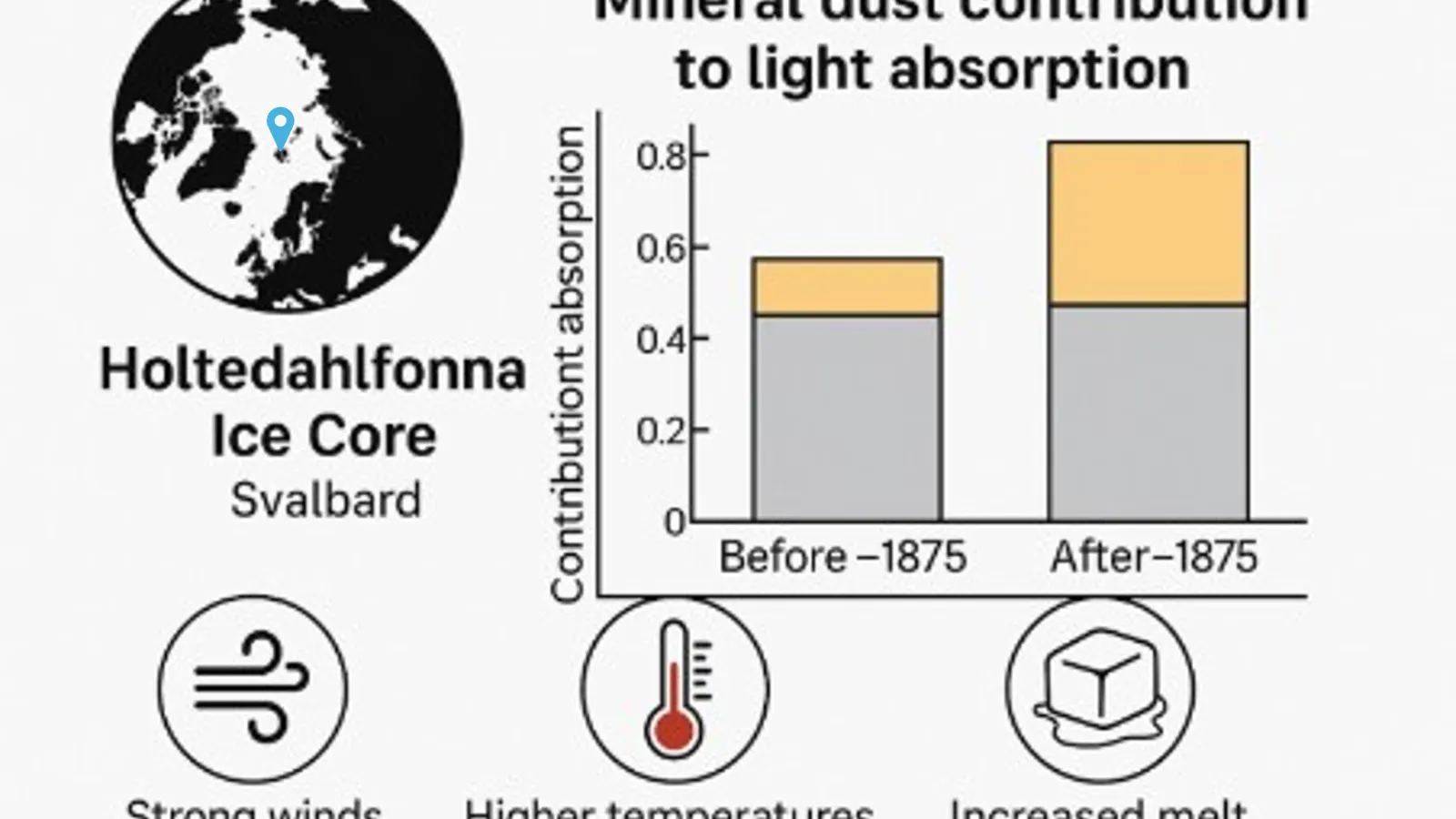
Droughts and wildfires, intensified by Earth’s current warming, generate increasing amounts of dust and soot particles. Rising temperatures decrease seasonal snow cover and are responsible for the emergence of sources of mineral dust aerosols in the Arctic. To understand how much dust and soot have each contributed to darkening snow over time, this study examined how particle trapped in a 300-year Arctic ice core absorbed light.
This paper proposes refractory combustion residues as a new proxy for dust in an Arctic ice core (Svalbard). Non-combustible residual is what remains after that heating because it doesn’t combust readily. The authors treat that leftover fraction as a proxy for mineral dust. They found that the relative contribution of mineral dust to light absorption increased from 50% to 70% between 1875 and 1970. After the 1970s, the relative contribution of mineral dust declines due to lower local wind speeds and increasing soot deposition on the glacier.