SWOT Wide‑Swath Altimetry Reveals Global River Bank Morphology and Storage Variability
The Ohio State University, School of Earth Sciences (SES) Professor and Interim Director of the Byrd Polar and Climate Research Center Michael Durand and his team have been published in Nature for their work on measuring rivers from space using the Surface Water and Ocean Topography (SWOT) satellite.
Rivers are Earth’s most renewable and accessible freshwater resource but historically global estimates of the magnitude and variability in river water storage has remained inconsistent. Previous estimates of variability have relied on sparse and asynchronous remote-sensing observations or on hydrological models which were constrained by an incomplete understanding of surface-water balance and poorly known river channel characteristics. This insufficient knowledge hinders the ability to effectively manage this critical freshwater resource.
Precise monitoring of global river fluxes and storage is becoming increasingly vital as river corridors and their biodiversity are threatened by global environmental change, intensifying extreme weather events, and rising anthropogenic pressures such as pollution, population growth, and transboundary conflicts.
In December of 2022, after 20 years of development the SWOT satellite was launched by NASA and the French space agency Centre National d’Études Spatiales, which is specifically designed to observe Earth’s continental surface waters including rivers, lakes, reservoirs, and wetlands. SWOT uses a Ka-band radar interferometer to map both water extent and water surface elevation. These observations can be used to map the active beds of river corridors and derive global river water storage variability.
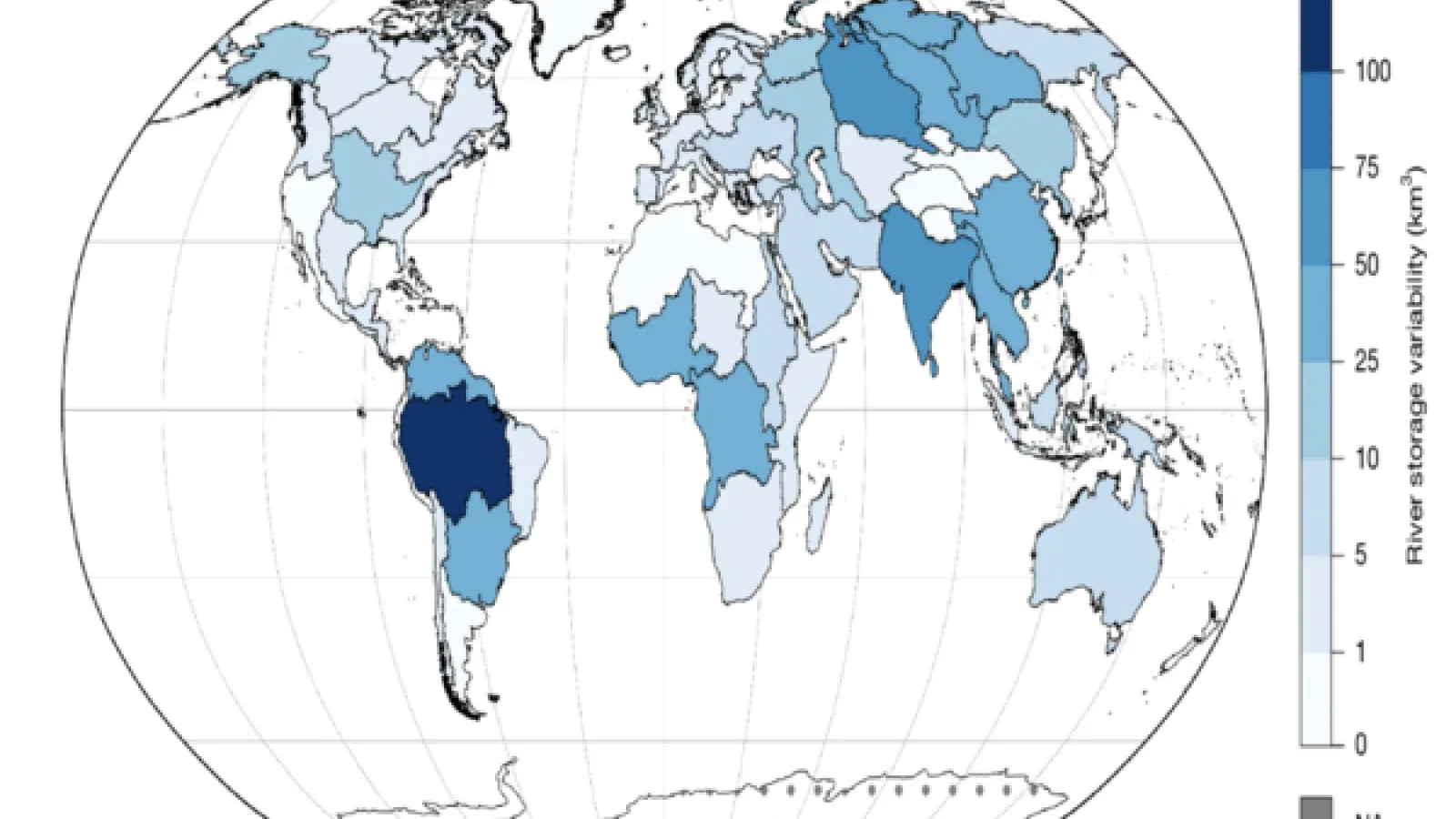
The study presents near-global measurements of the shape of active river corridors derived from SWOT observations during its first year of orbit (October 2023- September 2024). With this comes a near-global observation record of river storage variability. Observations reveal that rivers with comparable discharge can exhibit different channel shapes and highlight the wide morphological diversity of river systems across the globe. The observed storage changes help identify annual cycles and hotspots of global river storage variability. Although the observations come from the early stages of the satellite mission and still contain some uncertainty, comparisons with existing hydrological models highlight the need for major improvements in how global models represent river and surface-water dynamics. More accurate models could help scientists better manage water resources and predict water-related disasters such as floods and droughts.